
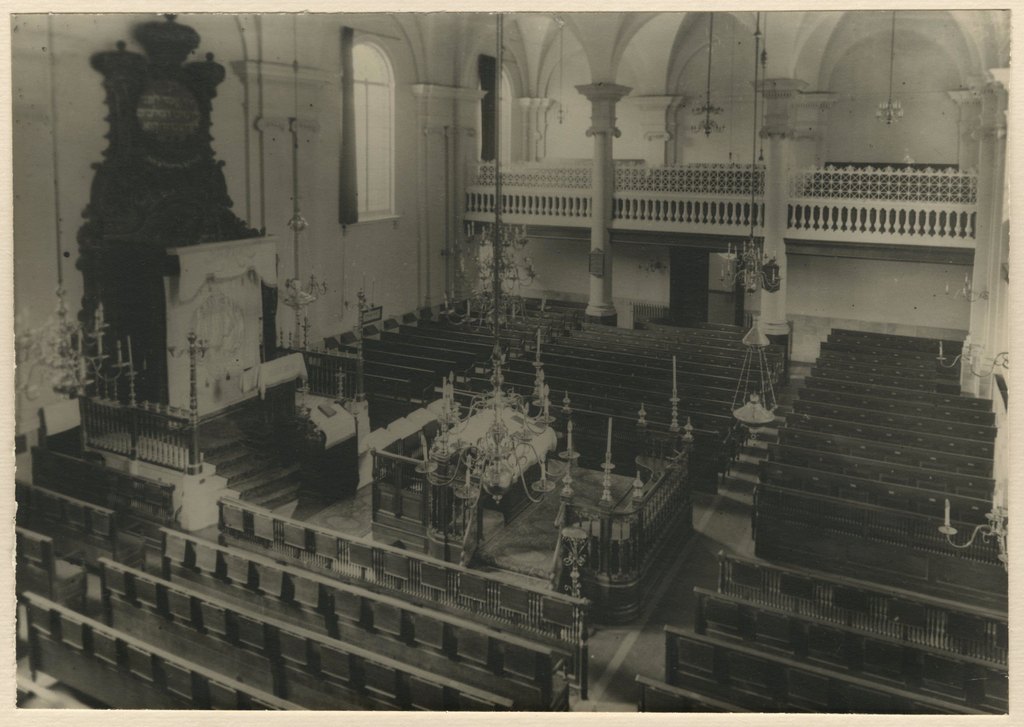
On the Wagenstraat, in the old Jewish quarter of The Hague that is now known as Chinatown, stands a small neoclassical temple front flanked by two blue-and-white minarets. For more than 130 years the building was the main synagogue of the city’s Ashkenazi community. Since 1979 it has been the Mescidi Aksa, the first and largest Turkish mosque in The Hague.
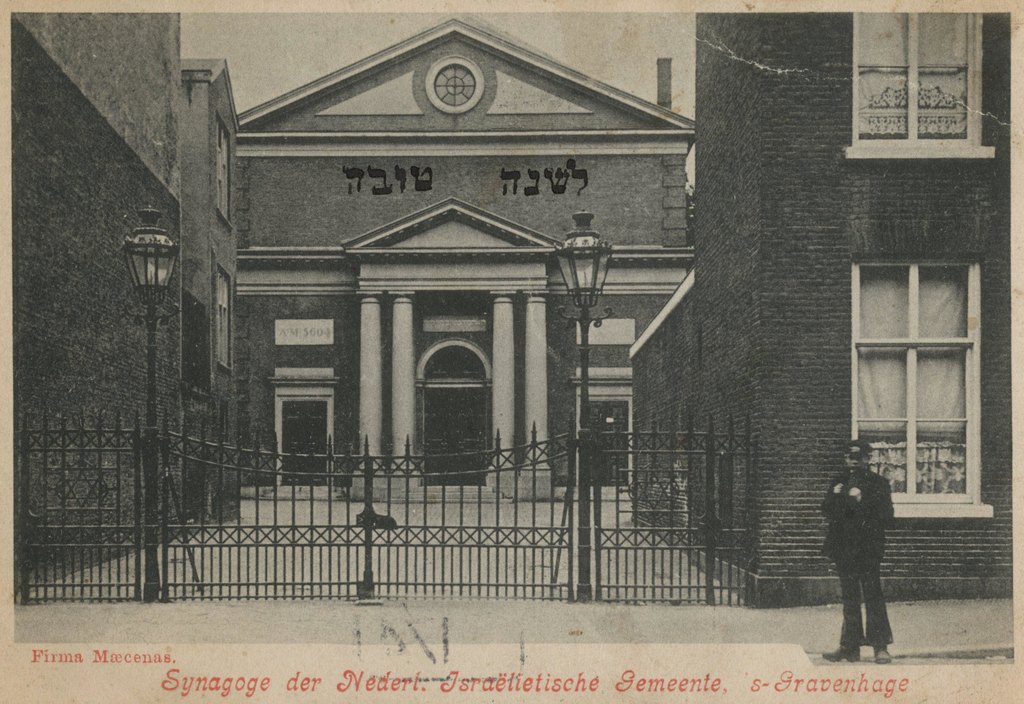
A synagogue on the Wagenstraat (1844)
The Ashkenazi, German-speaking Jewish community commissioned the architect Arend Roodenburg, who designed the synagogue in 1842 in the form of a Greek temple, with a triangular pediment on Tuscan columns. King Willem II contributed to the costs. Two houses on the Wagenstraat were demolished to give the building a proper entrance, and it was consecrated in 1844. For a century it hosted services, festivals and Jewish weddings; the building was enlarged in 1922.
War and destruction
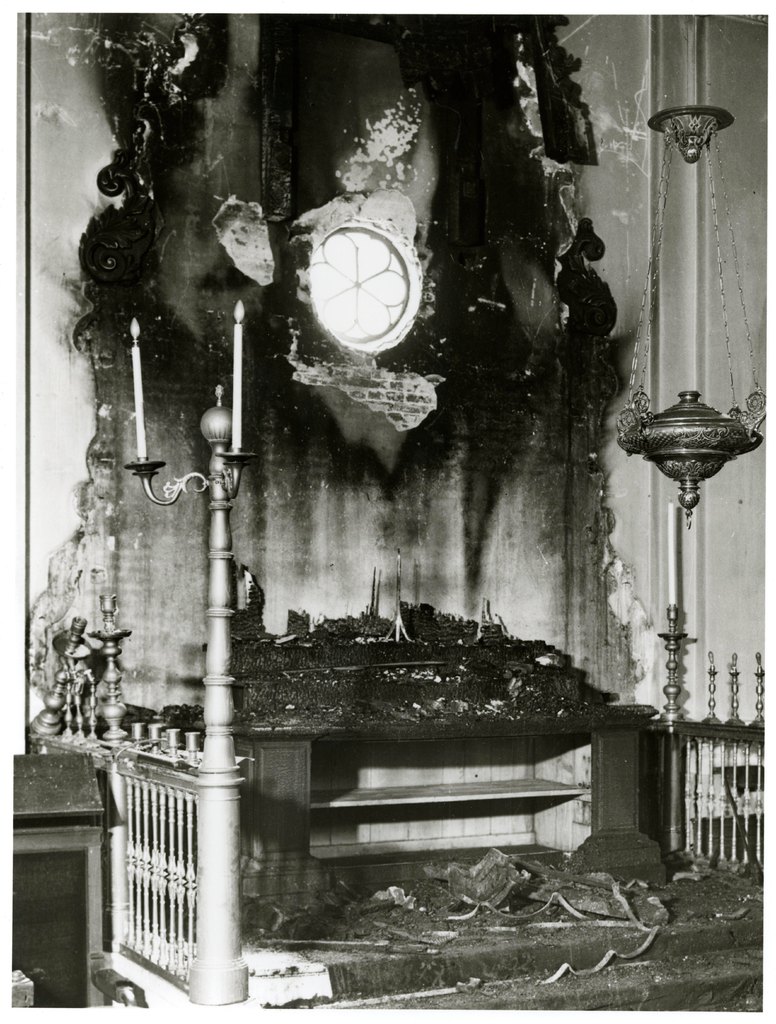
The German occupation ended the synagogue’s life as the centre of the community. On the night of Hitler’s birthday, 20–21 April 1941, the building was set on fire and the Holy Ark was destroyed. In 1942 members of the Dutch National Socialist Movement (NSB) wrecked the interior. Between 1942 and 1943 the Jews of The Hague were deported: of some 17,000, only about 2,000 survived.
An empty building (1945–1979)
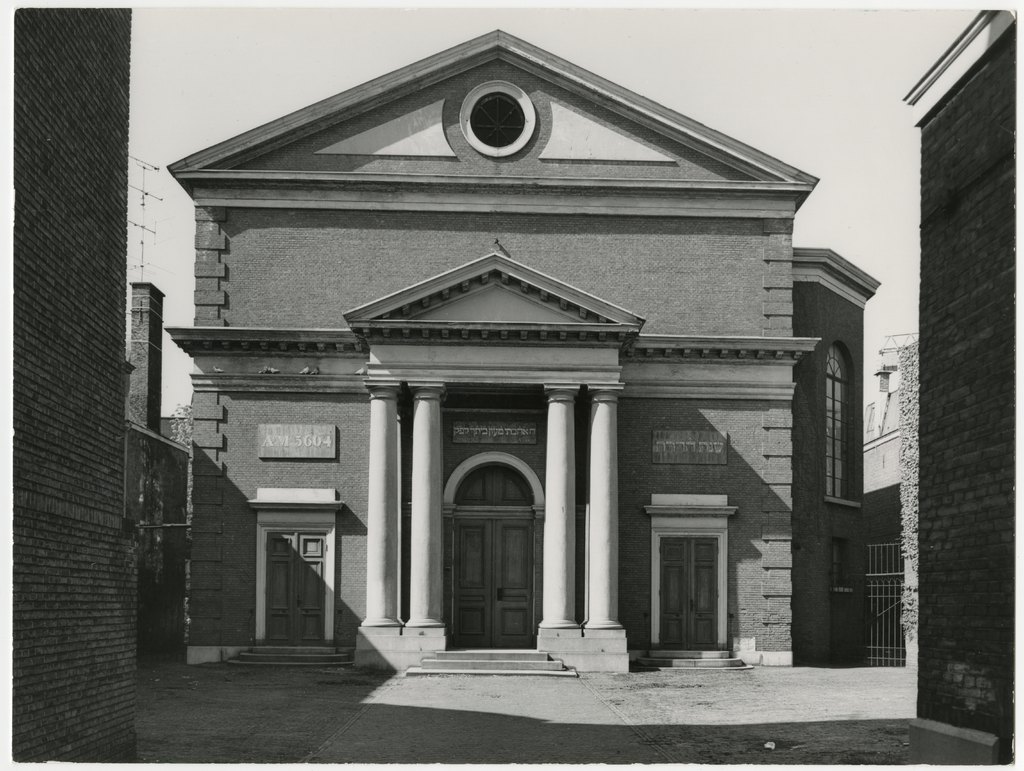
After the war the synagogues of The Hague were restored, but three were too many for the much smaller community. The Wagenstraat synagogue closed in 1975, and in 1976 the community sold it to the municipality for a symbolic guilder, on the condition that it would never become a church. The Holy Ark went to Israel. The empty building fell into disrepair and was used as a shelter by homeless people and drug users.
How it became a mosque (1979–1981)
Meanwhile, the Turkish community of The Hague, which had grown since the recruitment of guest workers in the 1960s, prayed in makeshift spaces. In 1978 a fire destroyed its provisional mosque in a former timber mill. On 27 July 1979, in the first days of Ramadan, members of the community occupied the empty synagogue. They stayed there day and night for about forty days to prevent eviction and left only when the municipality promised to sell. At first the city had refused to sell to the Turkish community, but in 1981 the building was sold to it for 1.4 million guilders.
The community turned the synagogue into a mosque. The ark, the ritual bath and the reading platform had gone; a mihrab indicating the direction of Mecca was placed in the wall, with a decorated minbar, calligraphy with the names of God, the Prophet and verses of the Qur’an, and the former women’s galleries were again given to women. The building was named after al-Masjid al-Aqsa in Jerusalem.
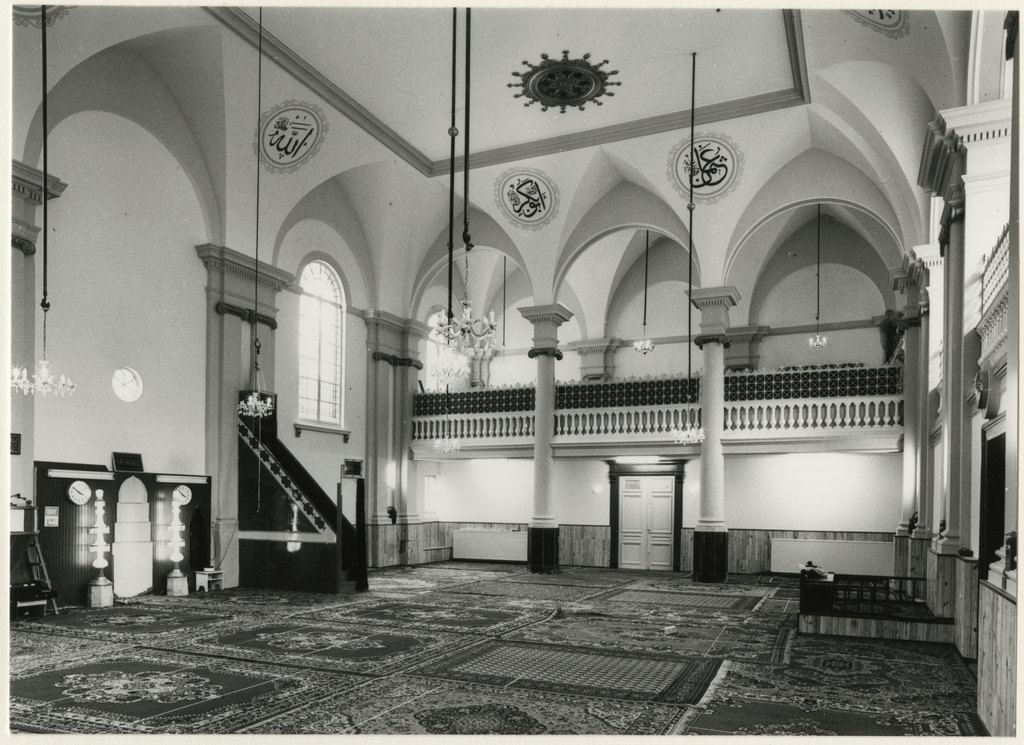
Monument and minarets (1983–1987)
On 19 October 1983 the building was listed as a national monument (rijksmonument 459778). In 1987 two steel minarets of some 26 metres, painted blue and white, were placed in the forecourt. They were new to the Hague skyline; a local newspaper felt the need to explain that they were not rockets but minarets.
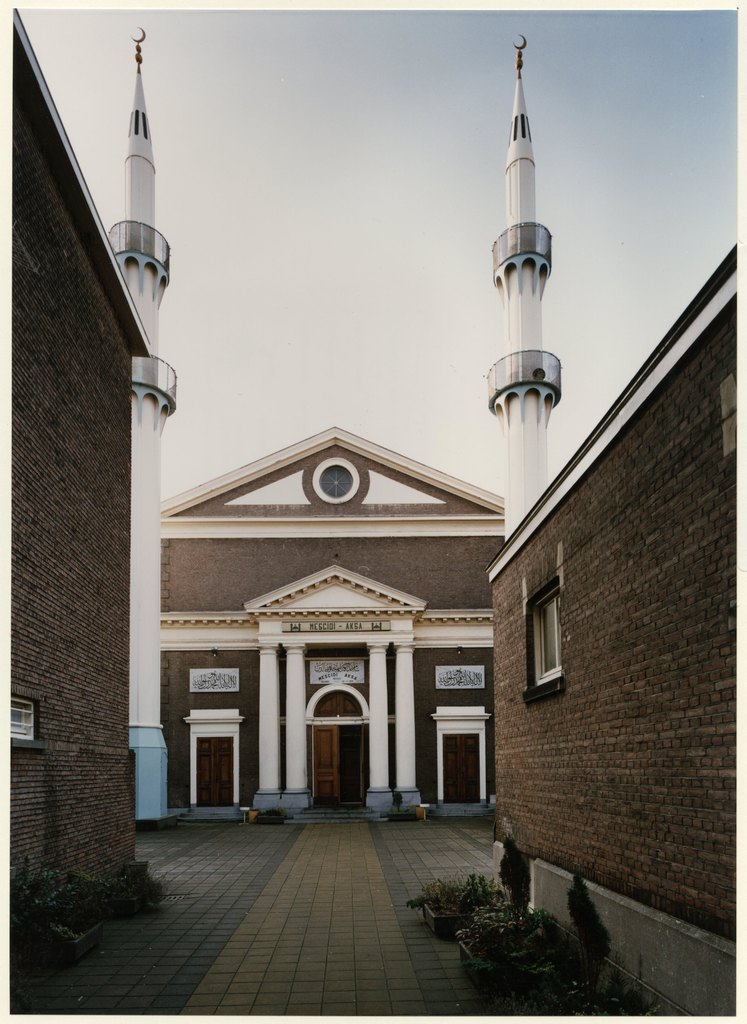
A Diyanet mosque today
Today the Mescidi Aksa belongs to the Hollanda Diyanet Vakfı, the Islamic Foundation Netherlands (ISN): the Dutch branch of Turkey’s Presidency of Religious Affairs (Diyanet), the largest mosque organisation in the country. Its imams are appointed through Diyanet, and the Friday sermon follows the texts the foundation prepares for its mosques. With room for about 1,500 worshippers, it remains one of the main mosques of the Turkish community in The Hague, and a meeting place in the city centre.
The building carries both histories. Its Jewish past is part of how the mosque presents itself to visitors, on guided tours “from synagogue to mosque”. For a sociology of religion in Europe, it is a rare case in which one minority’s house of worship, emptied by persecution, became the spiritual home of another minority that arrived as labour migrants.
Sources
- Haags Gemeentearchief, “Mescidi Aksa moskee: van synagoge naar Turkse moskee”, Verhalen van de stad; image collection.
- Haags Gemeentearchief, Joodse wandeling (walking guide to Jewish The Hague).
- Reliwiki, “’s-Gravenhage, Wagenstraat 103 – Grote Synagoge”.
- Geschiedenis van Zuid-Holland, “De synagoge van Den Haag”.
- Rijksdienst voor het Cultureel Erfgoed, monument register no. 459778.